Tuvalu
Tuvalu
- Capital
- Funafuti
- Population
- 11,792
- Region
- Oceania
- Languages
- English
Tuvalu generates a significant portion of its national income through the licensing of its country code top-level domain, .tv. In the late 1990s, the government signed a multi-million dollar contract to lease the suffix to technology companies, which helped fund infrastructure projects like school construction and paved roads. This digital asset remains one of the country's most valuable resources in the global internet economy. The revenue from these royalties even allowed the nation to join the United Nations in 2000 by covering the necessary membership dues.
Currency
The official currency is the Tuvaluan dollar (TVD), though it is used alongside the Australian dollar (AUD) at a one-to-one exchange rate. While Tuvalu issues its own unique coins featuring local marine life and cultural themes, it does not print its own banknotes and instead uses Australian bills for higher denominations. This unique dual-currency system was formalized in 1976 to provide economic stability during the country's transition to independence.
Flag symbolism
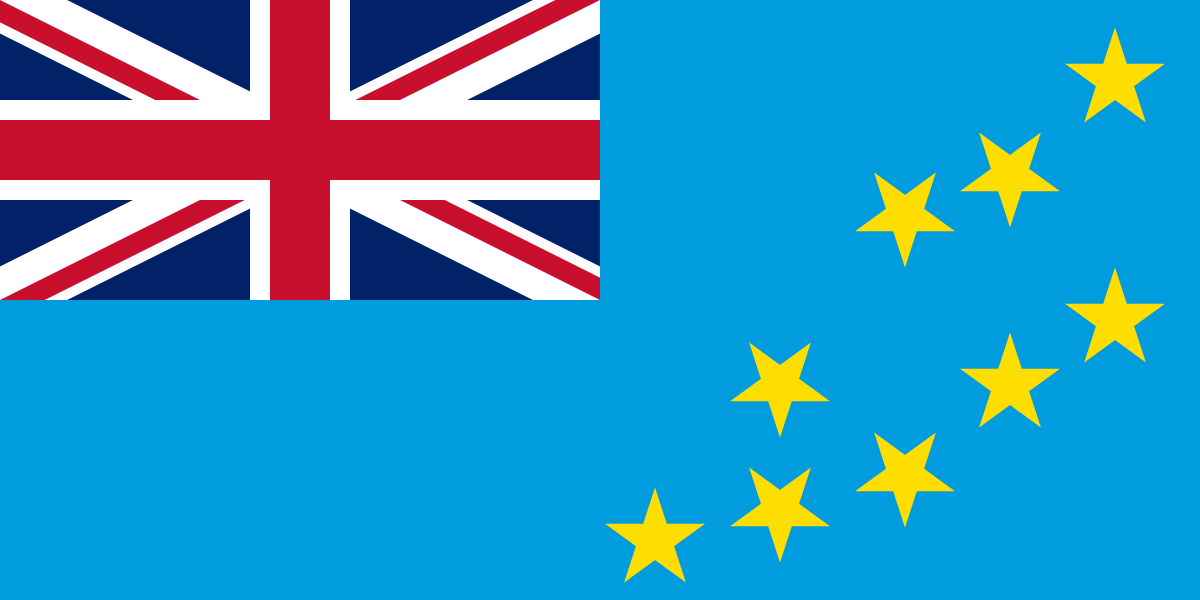
The light blue background of the national flag represents the vast expanse of the Pacific Ocean that surrounds the islands. Nine yellow five-pointed stars are arranged in a pattern that mimics the actual geographical positions of the nation's atolls and islands. While the Union Jack remains in the canton to acknowledge the historical constitutional links to the United Kingdom, the yellow stars signify the sovereign independence of the archipelago. The arrangement is oriented as if looking at a map, though the stars are pointed toward the hoist rather than upward.
Emblem history
The coat of arms features a central shield and a golden border decorated with eight banana leaves and eight cowrie shells, representing the traditional sustenance and wealth of the islands. Within the shield, a 'maneapa' or traditional community meeting house is depicted, standing as a symbol of local democracy and communal authority. Below the shield, a banner displays the national motto, 'Tuvalu mo te Atua,' which translates to 'Tuvalu for the Almighty.' This emblem was officially granted by the College of Arms in 1976, shortly before the nation achieved full independence from British administration.