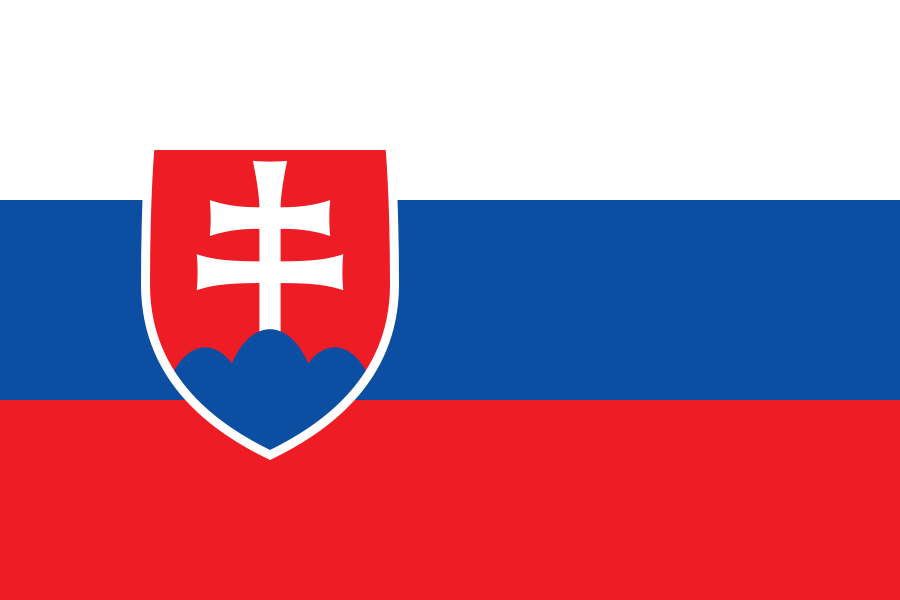
Slovakia
Slovakia
- Capital
- Bratislava
- Population
- 5,458,827
- Region
- Europe
- Languages
- Slovak
This nation is home to the world's highest concentration of castles and chateaux per capita, featuring spectacular ruins like Spiš Castle, which is one of the largest fortified complexes in Central Europe. Hidden beneath the surface, the country also boasts more than 6,000 caves, including the rare Ochtinská Aragonite Cave, which is one of only a few of its kind accessible to the public globally. Additionally, the village of Čičmany is famous for its unique folk architecture, where dark wooden houses are intricately decorated with white geometric patterns that resemble delicate lace.
Currency
The official currency is the Euro, denoted by the ISO code EUR. Before adopting the Euro in 2009, the nation used the Slovak Koruna, a currency that was uniquely introduced following the peaceful dissolution of Czechoslovakia in 1993.
Flag symbolism
The flag features three horizontal stripes of white, blue, and red, colors rooted in the Pan-Slavic movement of the 19th century and shared with various other nations in the region. To distinguish it from the Russian flag, the national coat of arms is positioned toward the hoist side, overlapping all three bands. The white represents peace and nobility, the blue signifies loyalty and the sky, while the red symbolizes the blood shed for the struggle of independence and valor.
Emblem history
The coat of arms depicts a silver double-cross rising from the central peak of three blue mountains against a red shield. This double-cross, or patriarchal cross, traces its origins back to the Byzantine Empire and was brought to the region by the missionaries Saints Cyril and Methodius. The three mountain peaks represent the Tatra, Fatra, and Matra ranges, symbolizing the historical highlands and geographic identity of the people. This emblem served as a national symbol during the 1848 revolution and was formally restored following the peaceful dissolution of Czechoslovakia.