Saint Pierre and Miquelon
Saint Pierre and Miquelon
- Capital
- Saint-Pierre
- Population
- 6,069
- Region
- Americas
- Languages
- French
Despite being closer to Canada than to Europe, the islands are the last remaining vestige of the former colonial empire of New France in the North Atlantic. Residents drive European cars, use the Euro as their currency, and follow French labor laws and school schedules. During the Prohibition era in the United States, the archipelago became a massive smuggling hub for legendary gangster Al Capone, who stored vast quantities of Canadian whiskey in local warehouses. Today, the territory maintains a unique time zone that is thirty minutes ahead of Newfoundland during certain parts of the year.
Currency
The official currency is the Euro (EUR), reflecting the territory's status as a French overseas collectivity. Interestingly, until the mid-20th century, the islands used their own specific Saint Pierre and Miquelon franc, which often featured unique local motifs like codfish and anchor designs.
Flag symbolism
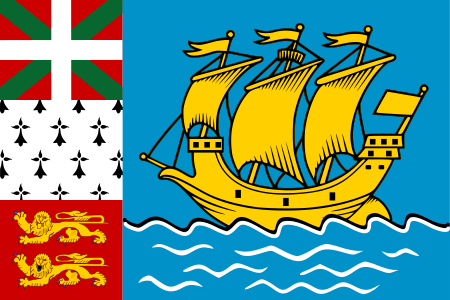
The unofficial local flag features a large yellow sailing ship on a blue field, which represents the Grande Hermine used by Jacques Cartier when he arrived in 1536. Along the hoist, three vertical square panels display the cultural heritage of the islanders through the Basque, Breton, and Norman flags. The red, white, and green Ikurriña represents the Basque settlers, while the ermine patterns and two gold lions represent Brittany and Normandy respectively. These symbols collectively honor the mariners from these three French regions who first settled the rocky archipelago.
Emblem history
The coat of arms prominently features the same 16th-century sailing vessel, the Grande Hermine, positioned above a banner with the Latin motto 'A Mare Labor', meaning 'From the Sea, Labor'. This motto emphasizes the historically vital role of the cod fishing industry that sustained the territory for centuries. Above the shield sits a naval crown, signifying the islands' strategic and maritime importance to the French Republic. Similar to the local flag, the coat of arms incorporates the traditional heraldry of the Basque, Breton, and Norman people to cement the islands' European cultural identity.