Palau
Palau
- Capital
- Ngerulmud
- Population
- 18,092
- Region
- Oceania
- Languages
- English
Palau is home to the world's first government-mandated shark sanctuary, covering an area of ocean roughly the size of France. This pioneering conservation effort protects over 135 species of Western Pacific sharks and rays from commercial fishing and finning. Visitors to the rock islands can also experience Jellyfish Lake, where millions of golden jellyfish have evolved to lose their sting after thousands of years of isolation. This allows swimmers to snorkel safely through a pulsating clouds of marine life found nowhere else on earth.
Currency
The official currency is the United States Dollar (USD). While Palau has used the American dollar since the post-World War II administration by the United States, the nation also issues non-circulating commemorative coins for collectors that often feature intricate marine life designs.
Flag symbolism
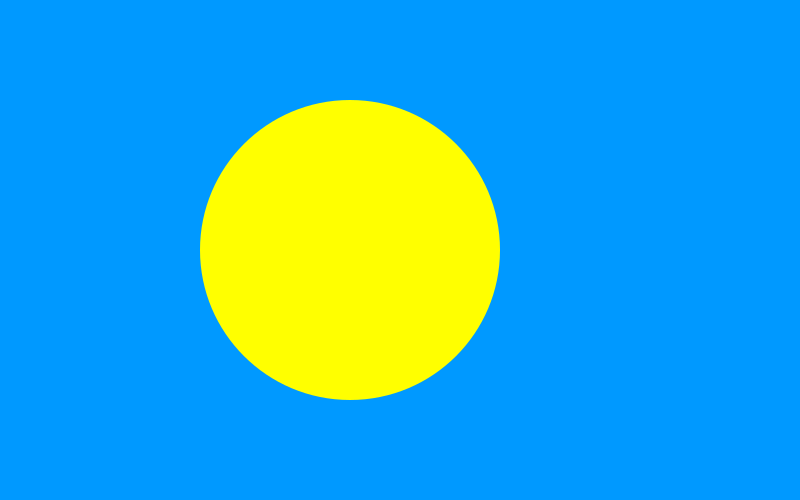
The flag features a golden-yellow disk set slightly off-center toward the hoist against a solid field of sky blue. While blue often represents the ocean for Pacific nations, here it specifically symbolizes the transition from foreign colonial rule to independence. The golden circle represents the full moon, which is a significant cultural marker for the timing of festivals, harvests, and traditional fishing cycles. By placing the moon off-center, the design achieves a visual balance when the flag is fluttering in the wind.
Emblem history
The National Seal of Palau is modeled after the architecture of a traditional 'bai', or men’s communal meeting house. Supported by stones, the wooden structure symbolizes the foundation of the state and the preservation of indigenous customs and laws. Sixteen crossbeams within the design represent the sixteen states of the republic, emphasizing unity among the different regions. This emblem was formally adopted in 1981 when the nation established its own constitution while transitioning away from the United Nations Trust Territory administration.