Mayotte
Mayotte
- Capital
- Mamoudzou
- Population
- 226,915
- Region
- Africa
- Languages
- French
Mayotte is home to a massive underwater volcano that was only discovered in 2018 after a series of seismic hums were recorded globally. This volcanic activity led to the birth of a new submarine mountain over 800 meters high on the ocean floor. The island also uniquely voted in a 2009 referendum to become a full French department, making it an outer limit of the European Union where the Euro is the official currency. Despite its political status, it retains a distinct culture where traditional matriarchal structures influence land ownership and family life.
Currency
The official currency is the Euro, denoted by the ISO code EUR, which reflects the department's political integration with Europe. Before adopting the Euro in 2002, the region utilized the CFA franc, which is still used by its independent neighboring islands in the Comorian archipelago.
Flag symbolism
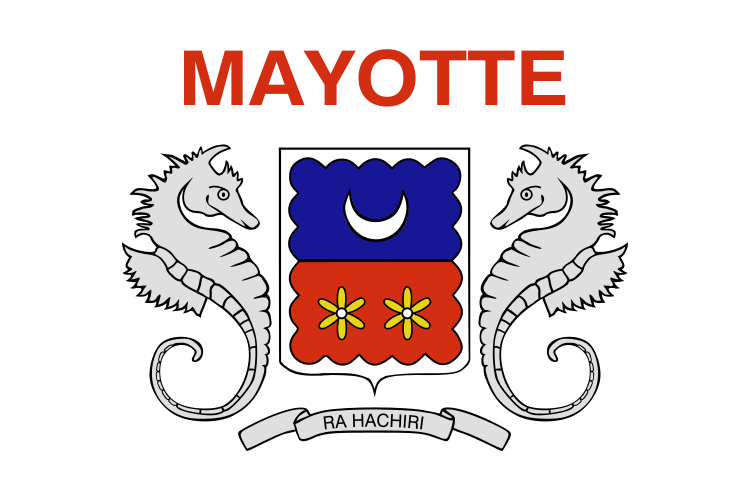
The official flag used in Mayotte is the French Tricolor, representing the territory's status as an overseas department of France. Because Mayotte does not have its own officially sanctioned local flag, a white banner featuring the coat of arms is often used informally for sporting and cultural events. The unofficial design incorporates the red and blue colors of the French flag to emphasize its political integration. The prominent clouds surrounding the coat of arms on the informal flag are intended to represent the tropical nature of the archipelago.
Emblem history
The coat of arms for Mayotte features a shield with a red and blue background divided by a white jagged line meant to signify a coral reef. Two seahorses act as supporters, reflecting the island's marine biodiversity and the shape of the main island, which some say resembles a seahorse. At the top of the shield, a crescent moon symbolizes the Islamic faith, which is the religion of the vast majority of the population. Two ylang-ylang flowers are positioned at the bottom, honoring the 'Perfume Island's' historical role as a major producer of floral essences.