Marshall Islands
Marshall Islands
- Capital
- Majuro
- Population
- 59,194
- Region
- Oceania
- Languages
- English, Marshallese
This island nation is home to the world’s largest shark sanctuary, covering an equatorial ocean area nearly four times the size of California. It is also the site of the first successful hydrogen bomb test, conducted at Eniwetok Atoll during a period of extensive post-war nuclear trials. Today, the country is a global leader in maritime registration, maintaining the second-largest shipping registry in the world. Surprisingly, much of the nation's traditional navigation history was recorded on 'stick charts,' which used palm fronds and shells to map complex ocean swell patterns.
Currency
The country uses the United States Dollar (USD) as its official legal tender. In 2018, the government passed the Sovereign Currency Act to create a blockchain-based digital currency called the 'Sovereign' (SOV) to circulate alongside the dollar, though its implementation has faced significant international regulatory scrutiny.
Flag symbolism
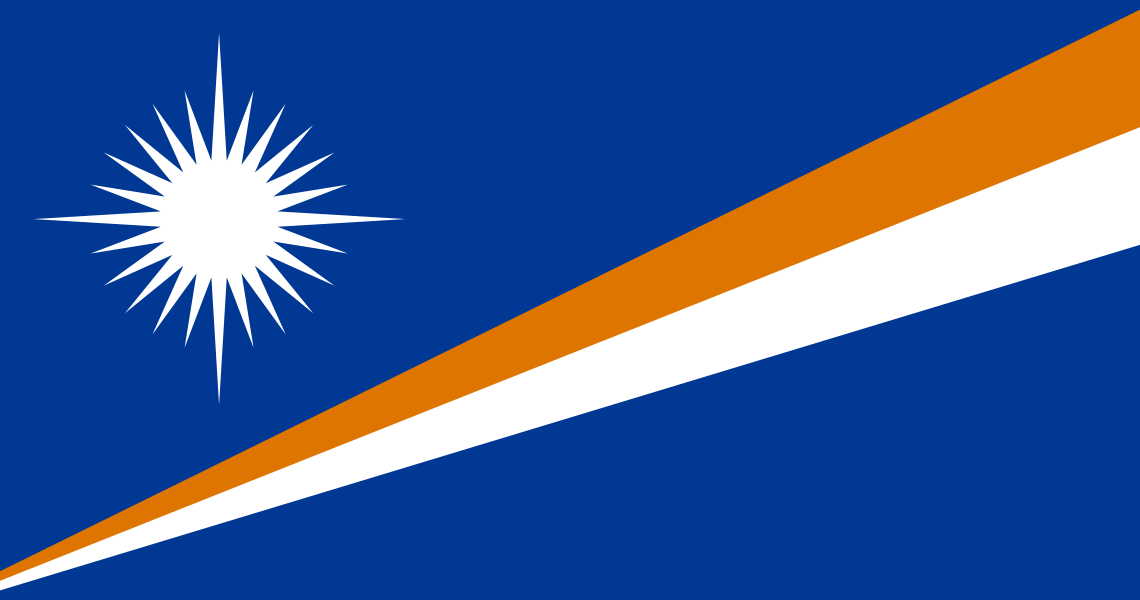
The flag features a deep blue field representing the Pacific Ocean, bisected by two diagonal stripes of orange and white. The orange stripe signifies the Ralik (sunset) island chain and denotes courage, while the white stripe represents the Ratak (sunrise) chain and symbolizes peace. An asymmetrical 24-pointed star sits in the upper hoist, with its four longest rays representing the Christian cross and the main administrative centers of the nation. The 24 points specifically honor the number of municipalities that comprise the island group.
Emblem history
The national seal of the Marshall Islands features a stylized angel with outstretched wings, symbolizing a protective spirit and the nation's faith. Centered on the seal is a traditional 24-pointed star, mirroring the national flag's design and its municipal representation. Flanking the central imagery are icons of local life, including a traditional outrigger canoe, a coconut palm, and a sennit fiber pounder. The seal was adopted in 1986 upon the establishment of the compact of free association, replacing the previous Trust Territory of the Pacific Islands insignia.