Maldives
Maldives
- Capital
- Malé
- Population
- 540,542
- Region
- Asia
- Languages
- Divehi
In 2009, the Maldivian government held the world's first underwater cabinet meeting to draw international attention to the threat of rising sea levels. The president and ministers donned scuba gear and sat at desks submerged on the sea floor to sign a climate change decree. This unique event highlighted that the nation is the lowest-lying country on Earth, with its highest natural point reaching less than three meters. Due to this vulnerability, the country has become a global leader in advocating for environmental preservation and sustainability.
Currency
The official currency is the Maldivian Rufiyaa, denoted by the ISO code MVR. Interestingly, before the introduction of coins and paper money, Maldivians used cowrie shells as their primary form of legal tender for centuries. These shells were so abundant and widely accepted that the Maldives was once known as the 'Money Islands' by ancient international traders.
Flag symbolism
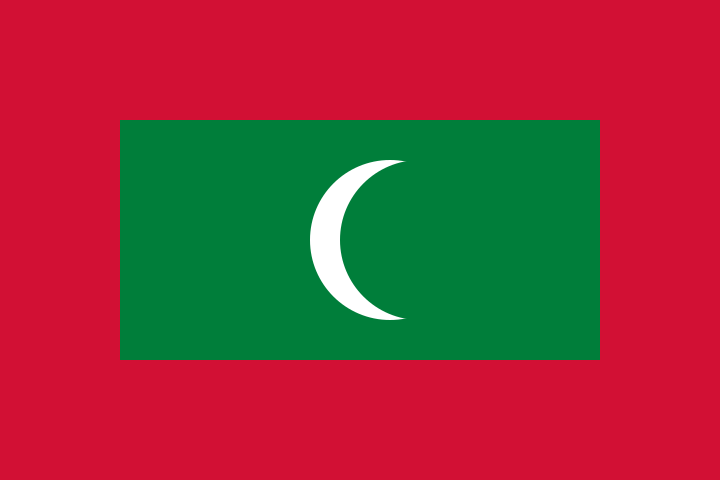
The flag features a green rectangle centered within a vibrant red border, with a white vertical crescent moon in the very center. The red section represents the bravery and sacrifices of the nation's heroes who fought for independence and sovereignty. The green rectangle symbolizes peace, prosperity, and the life-giving coconut palms that sustain the islands. The white crescent is a traditional symbol of Islam, reflecting the faith that serves as the moral foundation for the Maldivian way of life.
Emblem history
The national emblem of the Maldives consists of a coconut palm, a crescent moon and star, and two crossed national flags. The coconut palm reflects the primary traditional livelihood of the islands and was historically the most versatile resource for the population. Centered in the design are the crescent and star, which denote the Islamic faith of the state. These elements are accompanied by a scroll bearing the Arabic title 'Ad-Dawlat Al-Mahaldhibiyya,' which translates to the State of the Maldive Islands and traces back to the traditional sultanate era.