Libya
Libya
- Capital
- Tripoli
- Population
- 6,871,287
- Region
- Africa
- Languages
- Arabic
Libya is home to the remains of Leptis Magna, which is widely considered one of the best-preserved Roman cities in the entire world. It was also the birthplace of Emperor Septimius Severus, who significantly expanded and beautified the city during his reign. In the 20th century, the region earned a different kind of fame when a weather station in El Azizia recorded a temperature of 58 degrees Celsius, though this record was later disputed by meteorologists. The country's vast desert landscapes also contain the Akakus Mountains, featuring prehistoric rock art that dates back over 12,000 years.
Currency
The official currency is the Libyan Dinar, identified by the ISO code LYD. It was introduced in 1971 to replace the Libyan Pound at par value following the country's transition to a republic. Interestingly, during the mid-20th century, Libya was one of the first countries in the region to move away from using foreign colonial currencies in favor of its own sovereign monetary system.
Flag symbolism
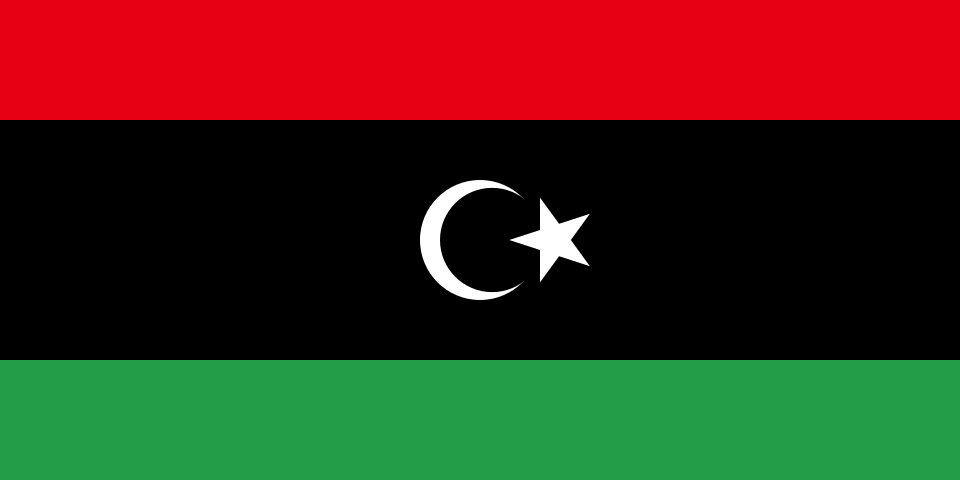
The national flag features a white crescent and star at its center, representing the Islamic faith and the guiding light of hope. The central black band symbolizes the historical Cyrenaica region and the Senussi order that led the movement for independence. The top red stripe represents the blood shed for freedom and the Fezzan region, while the bottom green stripe signifies the Tripolitania region and the country's agricultural heritage. This design was originally adopted in 1951 and was restored in 2011 to replace the solid green flag formerly in use.
Emblem history
The current national identification used on official documents is a circular seal featuring the colors of the national flag and the crescent and star. Historically, the nation was represented by the Hawk of Quraish, a symbol of the tribe of the Prophet Muhammad, which appeared on various coats of arms throughout the late 20th century. During the era of the Great Socialist People's Libyan Arab Jamahiriya, the emblem was a green shield held by the hawk to reflect the state's political philosophy. Today, the government often utilizes a simpler graphic emblem that avoids the complex heraldry of previous regimes to focus on national transitonal unity.