Greenland
Greenland
- Capital
- Nuuk
- Population
- 56,367
- Region
- Americas
- Languages
- Kalaallisut
Greenland is home to the world's largest national park, which covers an area larger than all but thirty of the world's independent countries. The island is also home to the Northeast Greenland Ice Stream, a massive frozen river that moves ice from the interior to the coast over hundreds of miles. Despite its name, the territory contains some of the oldest known rocks on Earth, dating back nearly 3.8 billion years in the Isua Greenstone Belt. Residents have developed a unique culinary tradition including kiviak, a winter delicacy made by fermenting little auks inside a seal skin.
Currency
Greenland uses the Danish Krone with the ISO 4217 code DKK, reflecting its political status within the Kingdom of Denmark. Historically, the territory used unique 'Greenlandic Krone' banknotes and distinct coins issued by the Royal Greenland Trading Department until the 1960s.
Flag symbolism
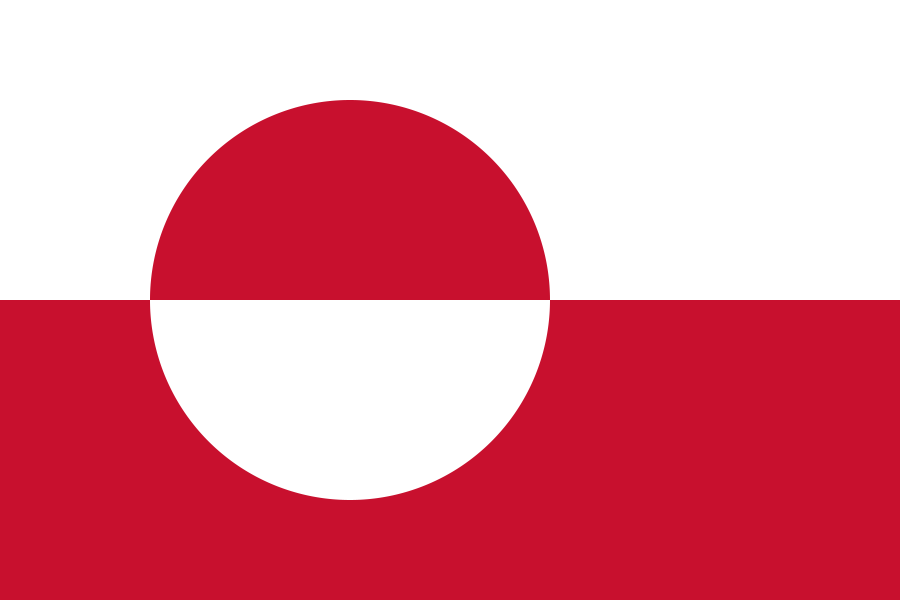
Designed by local artist Thue Christiansen, the flag is the only national banner of a Nordic territory that does not feature the traditional Nordic Cross. The white horizontal stripe represents the vast glaciers and ice caps that cover the majority of the landmass. The red stripe and the counter-colored circle symbolize the sun setting and rising over the horizon, reflecting the beauty of the Arctic light. Red and white were chosen to honor the historical and political connection with the Kingdom of Denmark while establishing a distinct Inuit identity.
Emblem history
The coat of arms features a blue shield depicting a silver polar bear standing in an upright position. Unlike common European heraldry where animals are shown with a raised right paw, the Greenlandic bear raises its left paw to reflect the Inuit belief that polar bears are left-handed. The blue background represents the Atlantic and Arctic Oceans that surround the island, while the bear symbolizes the rugged fauna and the northern spirit. This specific version was officially adopted in 1989, though the polar bear has appeared as a symbol of the territory in the Danish royal arms since the 17th century.