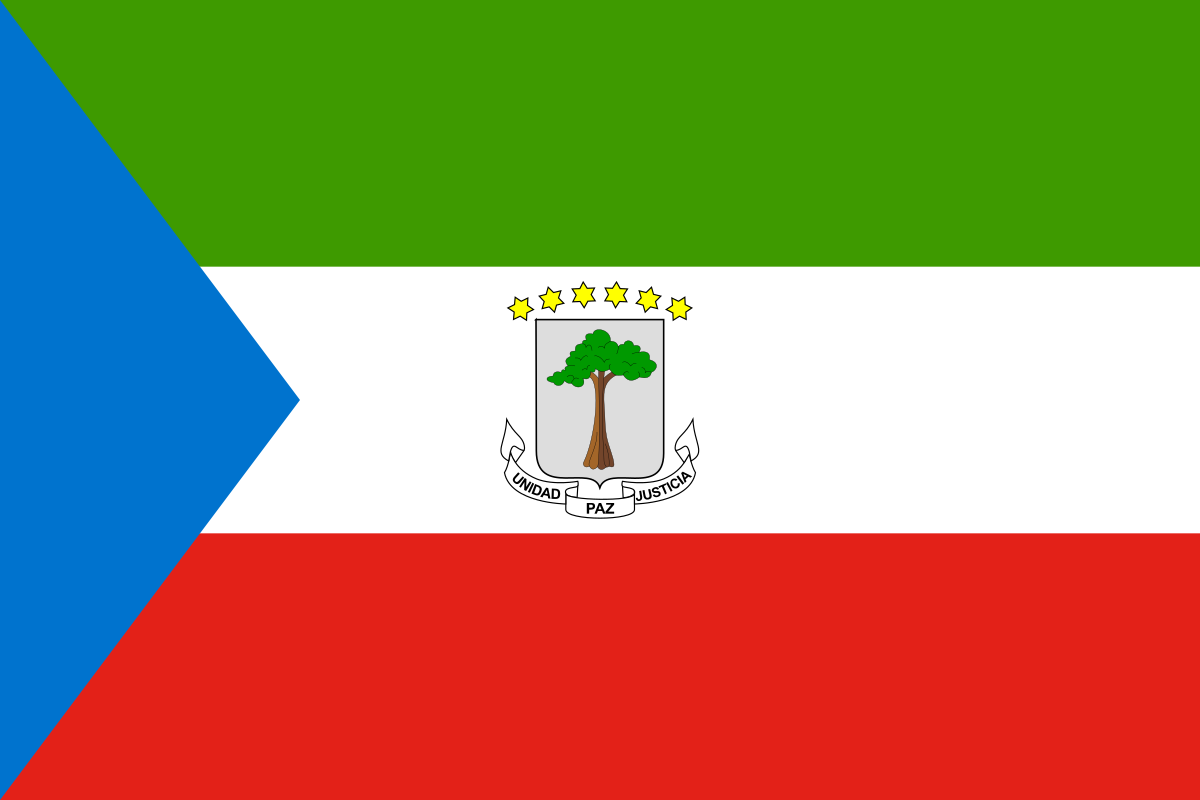
Equatorial Guinea
Equatorial Guinea
- Capital
- Malabo
- Population
- 1,402,985
- Region
- Africa
- Languages
- Spanish, French
Equatorial Guinea is the only sovereign country in Africa where Spanish is established as an official primary language, a legacy of its history as the colony of Spanish Guinea. Despite its name, no part of the country's territory actually touches the equator, as the mainland lies just north of it and the island of Annobón lies to the south. The nation’s capital, Malabo, is interestingly located on the island of Bioko rather than on the African mainland. This creates a unique administrative dynamic where the seat of government is separated from the majority of the country's landmass by the Gulf of Guinea.
Currency
The official currency is the Central African CFA franc, identified by the ISO code XAF. Although it was a Spanish colony, the nation switched from the Equatorial Guinean ekwele to the CFA franc in 1985, becoming the first non-Francophone country to join the CFA zone.
Flag symbolism
The flag features three horizontal stripes of green, white, and red, with a blue triangle positioned at the hoist. The green represents the country's lush vegetation and natural resources, while the white symbolizes peace and the red signifies the blood shed by fighters for independence. The blue triangle on the left side represents the sea, specifically the Atlantic Ocean that connects the mainland to the country's islands. Centered in the white stripe is the national coat of arms, which distinguishes it from similar horizontal tricolors.
Emblem history
The national emblem features a silver shield containing a silk cotton tree, also known as the God tree, which marks the spot where the first treaty was signed between Spain and a local ruler. Above the shield are six gold six-pointed stars that represent the mainland territory and the five offshore islands that comprise the nation. Below the shield is a scroll bearing the national motto 'Unidad, Paz, Justicia,' which translates to Unity, Peace, Justice. This design was originally adopted at independence in 1968, briefly altered during a period of political upheaval, and restored to its current form in 1979.