Guadeloupe
Guadeloupe
- Capital
- Basse-Terre
- Population
- 400,132
- Region
- Americas
- Languages
- French
Guadeloupe is shaped like a giant butterfly when viewed from above, with the two main islands separated by a narrow mangrove channel called the Rivière Salée. While these islands appear connected by bridges, they possess distinct geological identities; Basse-Terre features a towering active volcano, while Grande-Terre is primarily a flat limestone plateau. This unique geography allows the territory to host both dense rainforests and white sandy beaches within a single administrative unit. The island also holds a prestigious literary history as the birthplace of Saint-John Perse, who won the Nobel Prize in Literature in 1960.
Currency
The official currency is the Euro, which carries the ISO code EUR. Before its adoption in 2002, the islands used the Guadeloupean Franc, which circulated as a distinct local currency until it was eventually standardized with the mainland French Franc.
Flag symbolism
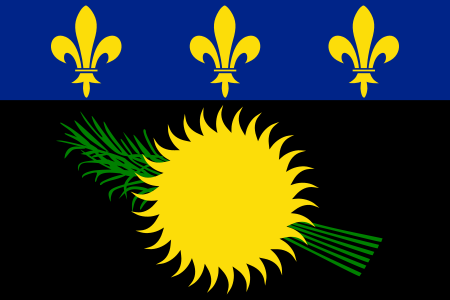
The official flag of Guadeloupe is the French Tricolor, representing its status as an overseas department of France with the values of liberty, equality, and fraternity. Locally, a common unofficial flag features a blue field with three golden fleur-de-lis, which pays homage to the historical French monarchy that colonized the area. Below these symbols is a stylized green square representing the lush vegetation and sugar cane, with a radiant golden sun in the center symbolizing the tropical climate. This unofficial design serves as a distinct regional identifier for residents despite not having legal status.
Emblem history
The emblem of Guadeloupe prominently features the fleur-de-lis, a traditional French royal symbol that appears in the upper tier of the crest. In the lower section, a bundle of green sugar cane stalks is depicted against a blue background, representing the historical backbone of the island's plantation economy. These elements often appear alongside a sun-disc, which reflects the island's identity as a 'jewel' of the Caribbean. The design has remained remarkably consistent over centuries, emphasizing the enduring cultural and historical ties between the archipelago and mainland France.