Gibraltar
Gibraltar
- Capital
- Gibraltar
- Population
- 33,691
- Region
- Europe
- Languages
- English
Gibraltar is home to the only wild population of primates in all of Europe, the Barbary macaques. Legend holds that as long as these monkeys remain on the rock, the territory will remain under British rule. To ensure this, the population is carefully protected by the Gibraltar Ornithological and Natural History Society. Interestingly, some of the local macaques have been observed using complex social maneuvers to interact with tourists, often displaying surprising intelligence and dexterity.
Currency
The official currency is the Gibraltar Pound, which uses the ISO code GIP and is pegged at a one-to-one value with the British Pound Sterling. Interestingly, while it is legal tender in Gibraltar and interchangeable with UK coins and notes locally, the specific Gibraltar-issued banknotes are generally not accepted in retail shops within the United Kingdom.
Flag symbolism
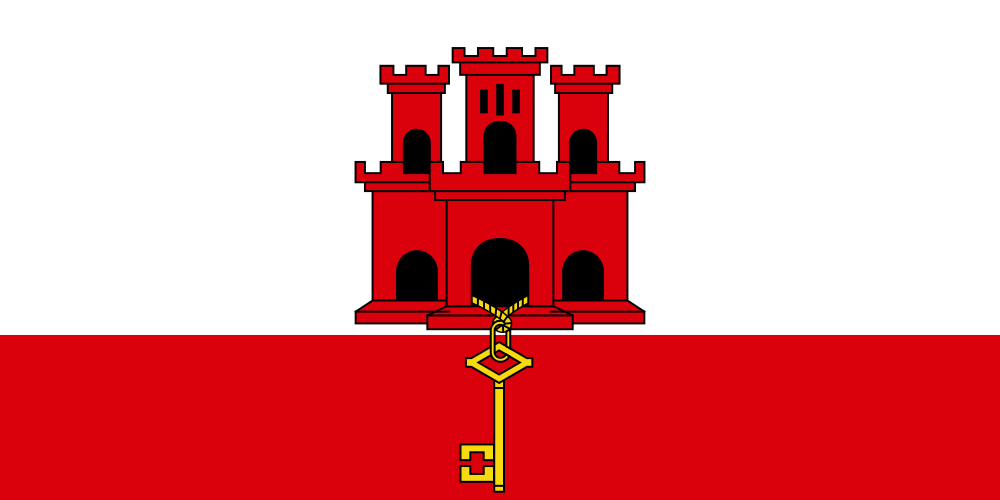
The flag features a white field with a red stripe along the bottom, depicting a three-towered red castle in the center. A golden key hangs from the castle's gate, symbolizing the territory's strategic importance as the entrance to the Mediterranean Sea. The red and white colors are based on the historical coat of arms granted by Queen Isabella I of Castile. This design is unique among British Overseas Territories as it does not incorporate the Blue Ensign or the Union Jack in its primary composition.
Emblem history
The coat of arms of Gibraltar was first granted by a Royal Warrant from Queen Isabella I of Castile in 1502 during the Spanish period. It features a three-towered castle that represents the fortress of Gibraltar and a golden key representing its role as a locked gateway. Despite the territory passing to British control under the Treaty of Utrecht in 1713, the original Spanish-granted arms were retained and later officially confirmed by British authorities. The Latin motto 'Montis Insignia Calpe,' meaning 'Insignia of the Mountain of Calpe,' refers to the ancient Greek name for the rock.