Guernsey
Guernsey
- Capital
- St. Peter Port
- Population
- 62,999
- Region
- Europe
- Languages
- English, French
During the Second World War, Guernsey was one of the few British territories to be occupied by German forces, leading to a unique period of history where local currency was printed on the backs of French bank notes. To keep spirits high, residents famously defied occupiers by painting 'V' for victory signs in public places and using illegal crystal radio sets to listen to the BBC. Many children were evacuated to mainland Britain just before the invasion, resulting in a generation that returned years later with different accents and customs. Today, the island celebrates its Liberation Day on May 9th as a major national holiday.
Currency
The official currency is the Guernsey Pound, which uses the unofficial ISO code GGP but is pegged at parity with the British Pound (GBP). An interesting historical note is that Guernsey issued its own banknotes as early as 1816 to fund the construction of coastal defenses and public markets without incurring interest-bearing debt. While local notes and coins are legal tender on the island, they are generally not accepted in the United Kingdom.
Flag symbolism
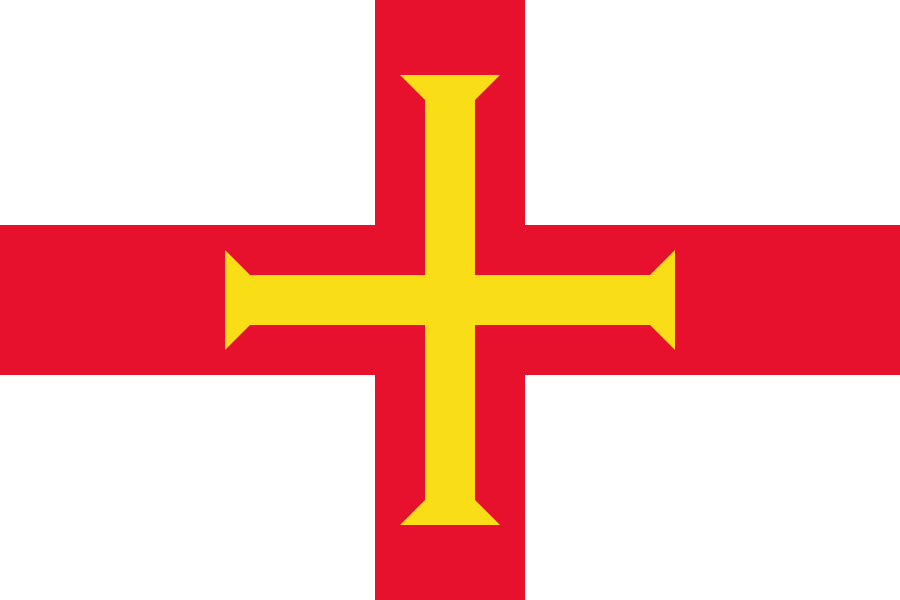
The flag features the red cross of Saint George, which reflects the island's long-standing historical relationship with the British Crown. Superimposed upon the red cross is a smaller gold cross of William the Conqueror, which was added in 1985 to distinguish the island's flag from that of England. The specific design of the gold cross is based on the banner carried by William at the Battle of Hastings in 1066. This combination of symbols represents Guernsey's dual identity as a British Crown Dependency with distinct Norman roots.
Emblem history
The coat of arms of Guernsey consists of a red shield featuring three gold lions, also referred to as leopards, stacked vertically. This design is almost identical to the arms of England and Jersey because it originates from the royal seal granted to the island by King Edward I in 1279. A unique distinguishing feature of the Guernsey version is a small sprig of golden leaves, or a branch, sprouting from the top of the shield. This heraldry emphasizes the island's ancient status as part of the Duchy of Normandy, a connection that predates the modern United Kingdom.