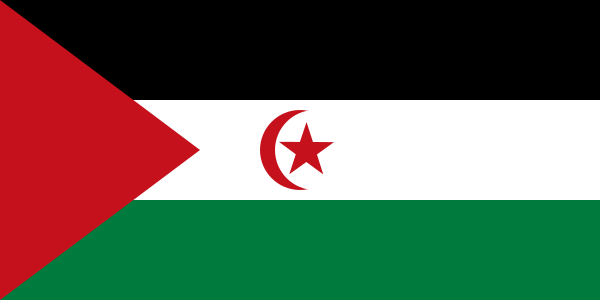
Western Sahara
Western Sahara
- Capital
- El Aaiún
- Population
- 510,713
- Region
- Africa
- Languages
- Spanish
Western Sahara is home to one of the most significant collections of prehistoric rock art in the Maghreb, particularly at sites like Sluguilla Lawash. These ancient engravings depict a diverse range of animals including elephants, giraffes, and rhinoceroses, proving that the region was once a lush savanna rather than an arid desert. Additionally, the territory is famous for its massive mobile sand dunes known as barchans, which can move several meters per year under the influence of the constant trade winds. The region also features some of the world's longest conveyor belts used to transport phosphate over sixty miles from inland mines to the coast.
Currency
The official currency is the Sahrawi Peseta with the unofficial code EHP, though the Moroccan Dirham is most common in practical daily use. The peseta was introduced in 1975 to assert national identity and maintains a fixed exchange rate linked to the Spanish Peseta, reflecting the territory's colonial history.
Flag symbolism
The flag utilizes the Pan-Arab colors of black, white, and green, which symbolize the historical Abbasid, Umayyad, and Fatimid caliphates respectively. A red triangle on the hoist represents the Hashemite dynasty and the blood of those who fought for independence. In the center of the white stripe, a red star and crescent serve as traditional symbols of Islam, which is the primary religion of the Sahrawi people. The design was inspired by the flag of the 1916 Arab Revolt and was officially adopted by the Polisario Front in 1976.
Emblem history
The national emblem features two crossed rifles known as Mausers, which are meant to symbolize the struggle for sovereignty and the defense of the land. Between the rifles sits a red crescent and star, reinforcing the cultural and religious identity of the Sahrawi Republic. Two olive branches frame the center of the emblem, representing the ultimate goal of peace and regional stability. This seal is frequently flanked by the national flag on both sides and often includes a scroll at the base with the national motto written in Arabic.