Cabo Verde
Cabo Verde
- Capital
- Praia
- Population
- 555,988
- Region
- Africa
- Languages
- Portuguese
Charles Darwin’s first major stop during his voyage on the HMS Beagle was Porto Praia, where he spent three weeks studying geology and marine life. This visit was pivotal as it provided him with his first encounter with tropical biodiversity and volcanic rock formations, helping to shape his early scientific theories. The archipelago is also famous as the birthplace of the 'morna' music genre, a melancholic and rhythmic style popularized globally by the legendary singer Cesária Évora. Today, the islands remain a critical sanctuary for loggerhead sea turtles, hosting one of the most significant nesting populations in the entire Atlantic Ocean.
Currency
The official currency is the Cape Verdean Escudo, identified by the ISO code CVE. Since 1998, it has maintained a fixed exchange rate pegged to the Euro, a relationship that evolved from an earlier agreement with the Portuguese Escudo to ensure economic stability.
Flag symbolism
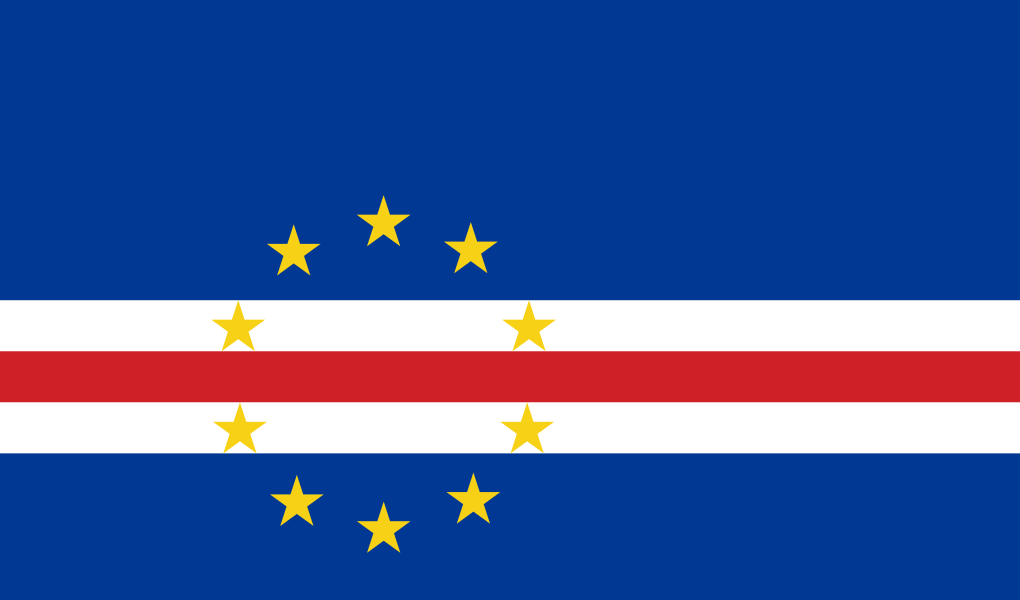
The flag features ten yellow stars arranged in a circle, representing the main islands of the archipelago integrated into a unified nation. The deep blue background symbolizes the vast Atlantic Ocean and the sky, while the horizontal stripes of white and red represent the road to progress and the peace required to build the country. The red stripe specifically acknowledges the effort and blood shed during the struggle for national independence. This design was adopted in 1992 to mark a transition toward multi-party democracy and to distinguish the nation from its previous shared revolutionary history with Guinea-Bissau.
Emblem history
The national emblem of Cabo Verde is a circular seal that prominently features an equilateral triangle of unity, containing a torch that symbolizes freedom. Encircling the central disk are ten stars, mirroring the flag's tribute to the islands, and a heavy plummet or plumb bob which represents justice and rectitude. Below the disk sits a stylized open book, signifying the importance of education and the preservation of national heritage. This emblem was established during the constitutional reforms of the early 1990s to replace the previous socialist-inspired iconography with symbols emphasizing democratic governance and civil stability.