Bonaire, Sint Eustatius and Saba
Bonaire, Sint Eustatius and Saba
- Capital
- Kralendijk
- Population
- 17,408
- Region
- Americas
- Languages
- Dutch
Despite their small size, the islands are home to Mount Scenery on Saba, which stands as the highest point in the entire Kingdom of the Netherlands at 887 meters. Saba is also famous for its 'Road,' a feat of engineering that was built entirely by hand by local residents after Dutch engineers claimed the terrain was too steep for any vehicle path. Because of their unique ecological diversity, the surrounding waters are designated as the Yarari Sanctuary, providing a protected habitat for various species of marine mammals and sharks. These islands are the only places in the world that use the United States Dollar as their legal tender despite being integral parts of a European nation.
Currency
The official currency is the United States Dollar (USD). It was formally adopted on January 1, 2011, making the islands one of the few places where a Dutch-affiliated territory has completely replaced the Netherlands Antillean guilder with American legal tender for daily use.
Flag symbolism
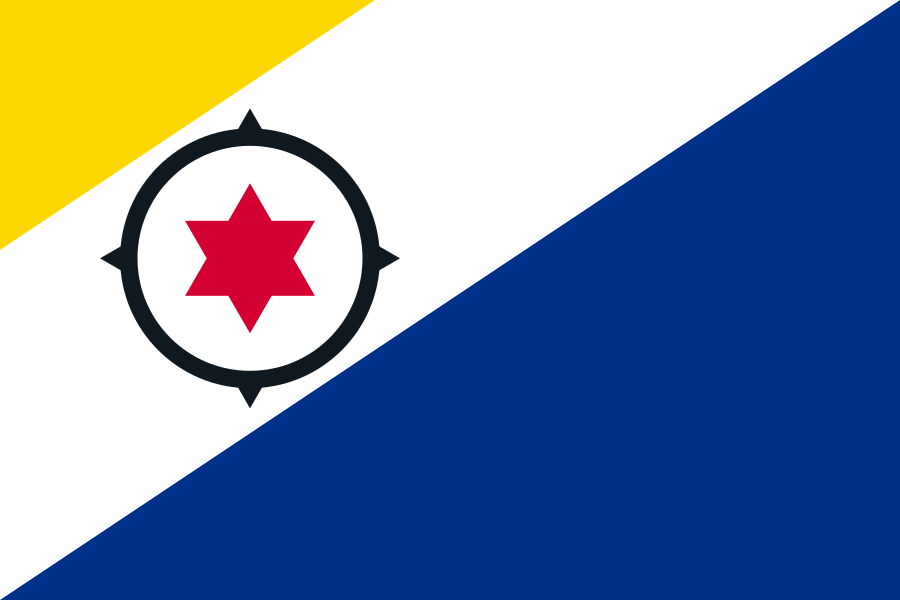
As a collective administrative unit, these islands fly the national flag of the Netherlands, featuring three horizontal bands of red, white, and blue. The red stripe historically signifies bravery and strength, while the white represent peace and honesty. The blue band symbolizes loyalty and justice, reflecting the long-standing maritime heritage and legal connection between the islands and the European mainland. This tricolor design serves as a unifying symbol for all three distinct special municipalities within the Caribbean territory.
Emblem history
The three islands do not share a single collective coat of arms, but rather maintain their own individual heraldic identities granted by Royal Decree. Bonaire’s emblem features a steering wheel and a compass rose, representing its nautical history and the direction of its people. Saba's coat of arms showcases the mountain and a local ship, reflecting its volcanic origin and maritime self-reliance. Sint Eustatius displays a central shield with a fort and a Caribbean queen conch shell, honoring its historical role as a trade hub known as the 'Golden Rock.'