
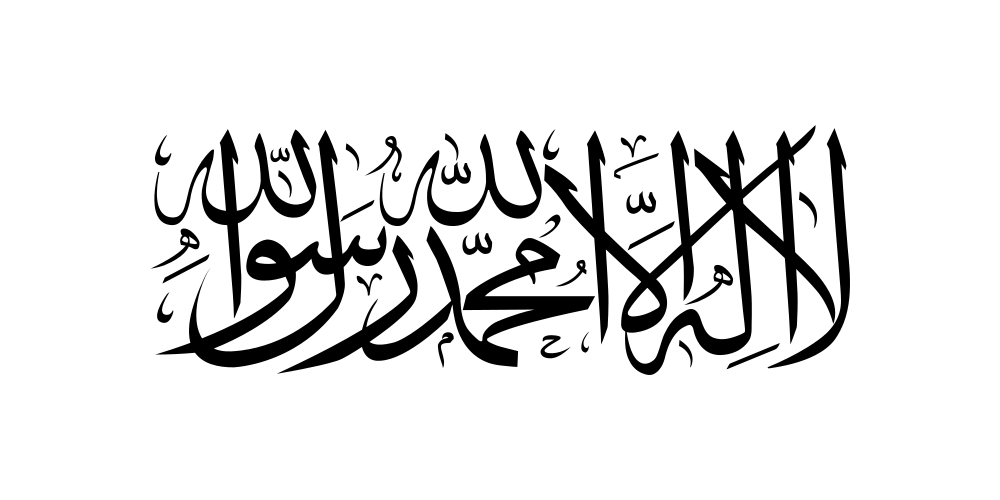
Used by the Taliban administration. Not recognized by the United Nations.
Afghanistan
Afghanistan
- Capital
- Kabul
- Population
- 43,844,000
- Region
- Asia
- Languages
- Dari, Pashto, Turkmen
Afghanistan is home to the world’s oldest known oil paintings, which were discovered in the caves of Bamiyan and date back to the 7th century. These ancient murals predated the use of oil paints in Europe by hundreds of years, showcasing a sophisticated mastery of organic binders. The country also sits on vast mineral wealth, including significant deposits of lapis lazuli that have been mined for over 6,000 years. This deep-blue gemstone from the Hindu Kush mountains was highly prized by the pharaohs of Ancient Egypt for use in funeral masks and jewelry.
Currency
Afghan Afghani (AFN) The afghani has been Afghanistan's currency since 1925. The name simply means "Afghan" in the local languages. Following decades of conflict and economic instability the currency was redenominated in 2003 as part of post-Taliban reconstruction efforts, with 1,000 old afghanis exchanged for 1 new afghani in an attempt to stabilise the economy.
Flag symbolism
Afghanistan holds a world record few nations would envy — it has changed its national flag more times than any other country in modern history, with over 20 different flags since 1747. Every change of government, from monarchy to communism to Taliban rule, brought a new flag. No other nation uses its flag so precisely as a political barometer. The flag shown here is the UN-recognised tricolour of the Islamic Republic — three vertical stripes of black, red and green, each carrying its own meaning. Black represents Afghanistan's troubled colonial past and the dark chapters of foreign occupation. Red honours the blood shed for independence. Green symbolises hope, prosperity and Islam as the state religion. At its centre sits the national emblem — a mosque with its mihrab facing Mecca, framed by sheaves of wheat and two Afghan flags, with the date 1298 in the Solar Hijri calendar marking independence from Britain in 1919. Below is the current de facto flag flown by the Taliban-controlled Islamic Emirate since August 2021 — a plain white field bearing the black Shahada in calligraphic script. It carries no national symbols, no colours, no emblem. Religion replaces nationhood entirely. This flag is not recognised by the United Nations, which continues to seat Afghanistan under the tricolour. Two flags, one country — and which one flies depends entirely on who you ask.
Emblem history
The emblem of the former Islamic Republic features a mosque at its centre, its mihrab pointing toward Mecca, framed by two Afghan flags. Below the mosque sits a rising sun, and the whole design is encircled by sheaves of wheat — representing agricultural prosperity. The date 1298 appears in the Solar Hijri calendar, marking Afghanistan's declaration of independence from Britain in 1919. The current Taliban-controlled state stripped the emblem entirely from its flag, replacing all national symbolism with the Shahada alone